
Blood-derived regenerative medicine · PRP 3.0
MNP Mechano-Native Plasma
MNP (Mechano-Native Plasma) is a new-generation regenerative plasma made from the patient's own blood, developed by Prof. Dr. H. Eray Copcu and known as PRP 3.0. No anticoagulant is added: the blood is allowed to clot natively, under control; platelets and leukocytes are activated mechanically; and the end product stays liquid.
The aim is to remove the drawbacks of classic PRP and of PRF, called PRP 2.0, and to obtain from plasma the most effective, highest-yield regenerative instruments.
- Source
- The patient's own blood
- Anticoagulant
- None: calcium stays free
- Clotting
- Native, controlled
- Activation
- Mechanical
- End product
- Liquid
- Device
- FibriTrap
- Stage
- Platelet, activated
- Leukocyte
- Exosomes, vesicles
- Growth factors, cytokines
- Ca²⁺
- Fibrin
Schematic, not to scale.
Why platelets
The first to answer an injury.
Platelets are among the most important regenerative instruments in plasma, and among the first to respond. When tissue integrity is broken they travel to the injured area and drive its repair through the growth factors, cytokines and exosomes they carry in their granules.
- 01
Leukocyte chemotaxis
Calls immune cells to the site
- 02
Angiogenesis
Supports new vessel formation
- 03
Fibroblast proliferation
Tissue repair and matrix synthesis
- 04
Extracellular matrix
Lays down the structural scaffold
- 05
Collagen remodelling
Balances the reshaping of tissue
- 06
Inflammation control
Modulates the immune response
Plasma itself is the carrier: more than 90% water, with proteins (growth factors, cytokines, chemokines), electrolytes, hormones and platelet-derived extracellular vesicles.
Three generations
PRP, PRF and MNP.
PRP has been used in regenerative medicine for a long time, with real advantages and real drawbacks. PRF was introduced to answer the drawbacks, yet both still have serious limits. MNP is designed to answer them.
PRP 1.0
PRP
Platelet-rich plasma, with anticoagulant
The anticoagulant binds calcium ions, so the native clotting mechanism, the one that should happen, is not allowed to run. Yet the mediators and cytokines of wound healing arise naturally through it, and regeneration needs calcium in the environment. The platelets obtained in PRP are not activated, either.
PRP 2.0
PRF
Platelet-rich fibrin, native clotting
Normal clotting is allowed, so more cytokines, growth factors and exosomes are produced. The real problem is where they end up: these valuable elements are trapped in a fibrin plug. The product is mostly used solid, and its liquid window is short.
PRP 3.0
MNP
Mechano-Native Plasma
Natural but controlled clotting keeps every growth factor and mediator in the environment; mechanical work activates platelets and leukocytes; and the end product is allowed to stay liquid.
| PRP | PRF | MNP | |
|---|---|---|---|
| Generation | PRP 1.0 | PRP 2.0 | PRP 3.0 |
| Anticoagulant | Yes: binds Ca²⁺ (citrate, EDTA) | None | None |
| Clotting | Blocked | Native | Native, controlled |
| Platelets | Not activated | Activated by thrombin | Activated natively and mechanically |
| Growth factors, cytokines, exosomes | Limited | Trapped in the fibrin matrix | Free in the liquid |
| End product | Liquid | Mostly solid; short liquid window | Liquid |
| In the coffee analogy | Instant coffee | Turkish coffee | Espresso |
The espresso hypothesis
Instant, Turkish, espresso.
The speaker group of the Blood-Derived Regenerative Medicine Workshop explains the three generations with coffee. The hypothesis behind the analogy is called the espresso hypothesis: the same bean, different methods, different results.
Instant coffee PRP: calcium bound PRP is instant coffee.
Quick · simple · ready
To stay liquid and convenient the system is stabilized chemically: the anticoagulant binds calcium and changes the natural clotting environment. Instant coffee is still coffee; PRP is still regenerative plasma.
Turkish coffee: the grounds PRF: the fibrin plug PRF is Turkish coffee.
Tradition · authenticity · the natural process
It keeps the natural process and does not chemically interrupt what nature means to do. But the essence of the coffee stays in the grounds at the bottom of the cup, and in PRF the regenerative elements stay in the fibrin plug.
“PRF is Turkish coffee, and I mean it as a compliment.”
Espresso: controlled extraction MNP: liquid, released MNP is espresso.
Precision · control · more possibility
Espresso is not a bean or a roast; it is an extraction method. Hot water passes through fresh, finely ground coffee under controlled pressure, and a small, dense cup carries what was already in the bean. MNP keeps the native environment, mobilizes the cells' biological content mechanically and, with FibriTrap managing the fibrin, keeps a usable liquid phase.
“We do not add the biological load of platelets and leukocytes from outside. We unlock the biological potential already there, with controlled mechanical energy.”
Preparation
From the patient's blood to liquid MNP.
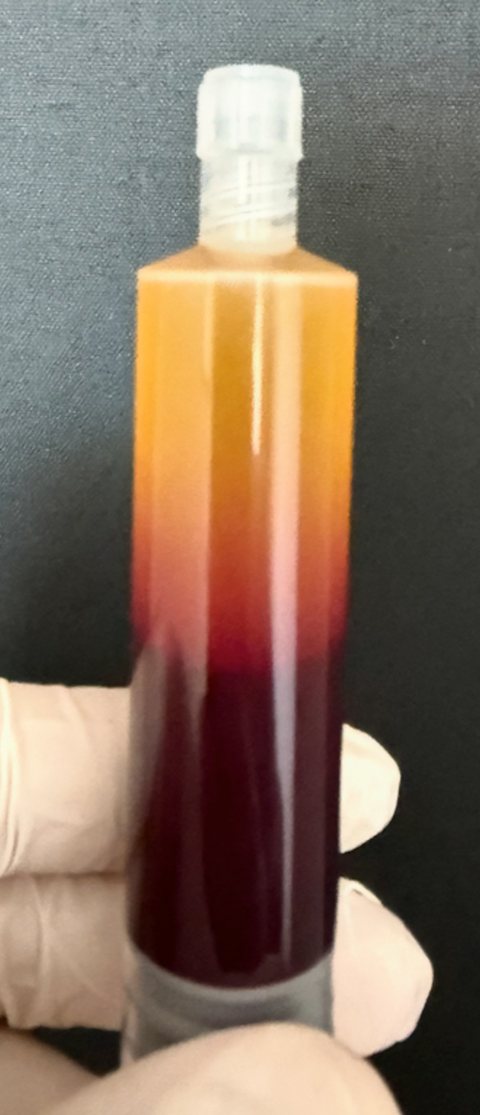
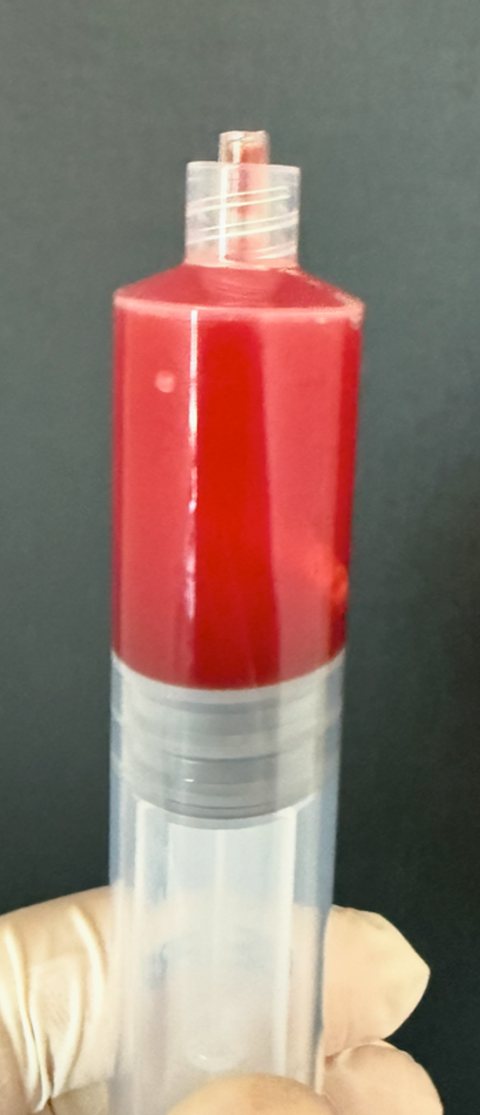
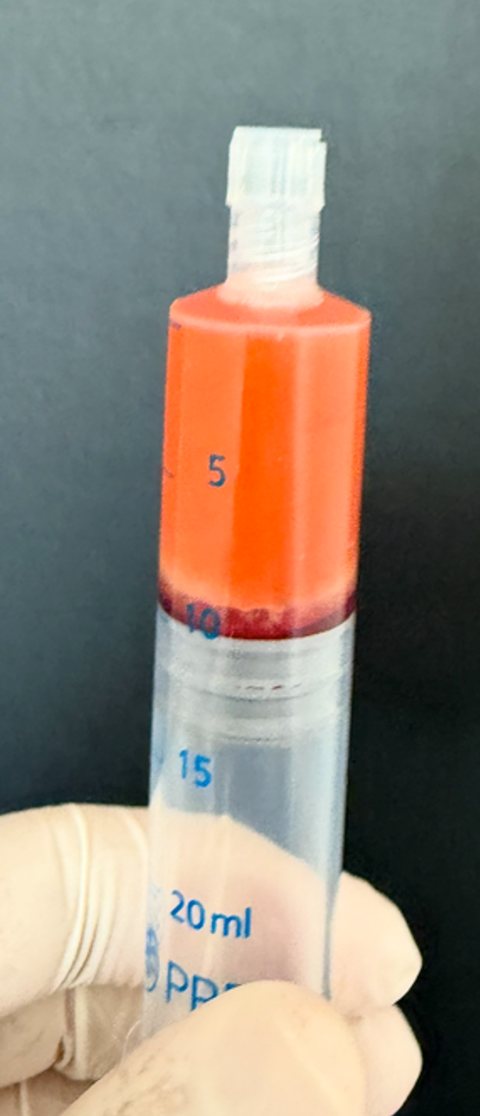
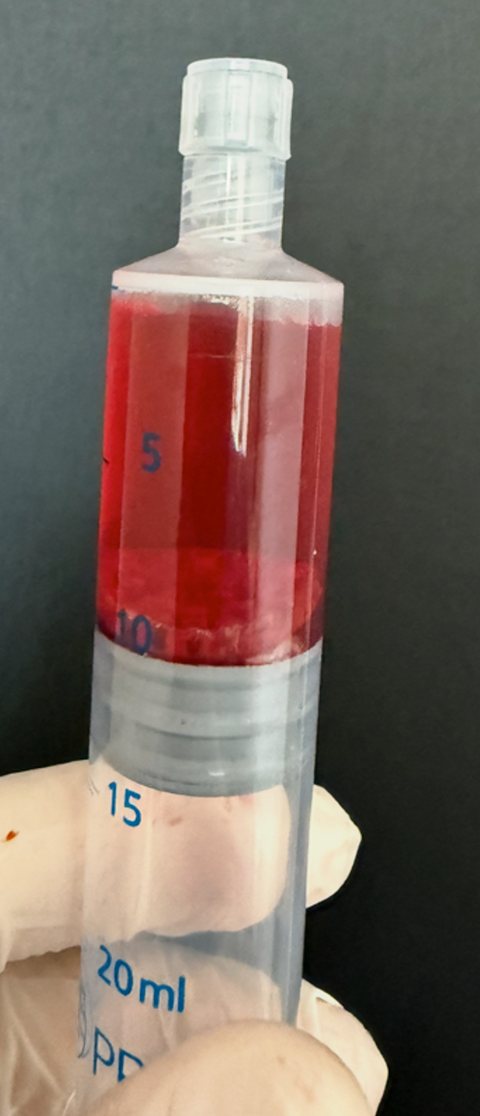
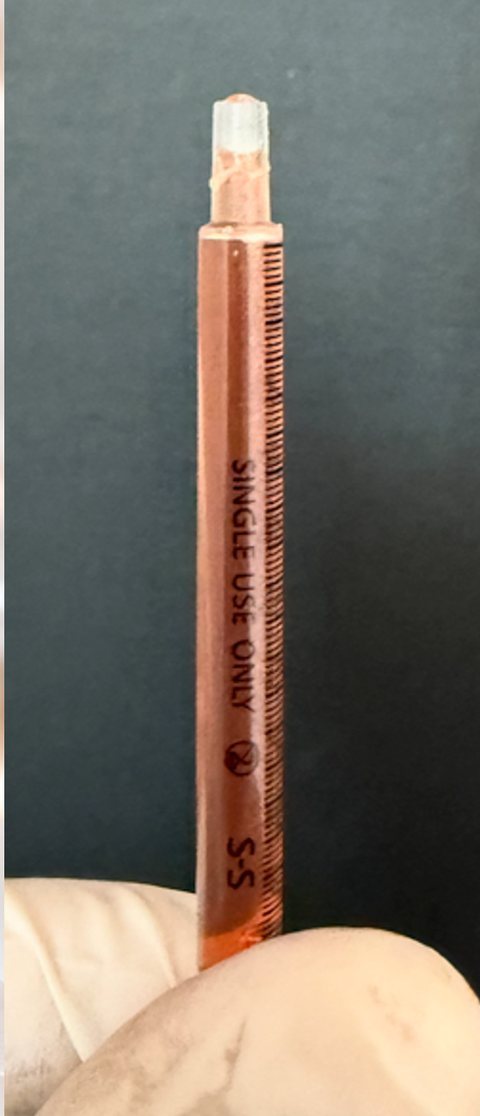
MNP is prepared in FibriTrap, the device developed with it. The sequence:
FibriTrap, formerly ExoDisc, is a disc that holds fibrin inside a defined structure so that the plasma around it stays liquid. Its geometry, materials, a “Dock & Drop” transfer system and instructions for use are in development, with patent work alongside.
- 1
Fresh blood
The patient's own blood is drawn, minimally invasively, and taken fresh into FibriTrap.
- 2
No anticoagulant
Nothing binds the calcium; the plasma keeps its natural niche.
- 3
Controlled mechanical interaction
Mechanical agitation activates platelets and leukocytes and brings out the regenerative elements.
- 4
Native coagulation
Clotting runs its natural course and releases its mediators, while FibriTrap holds the fibrin.
- 5
Liquid MNP
A liquid fraction rich in platelet-derived vesicles, growth factors and cytokines, ready to use.
Six principles
- 01
Mechano-activation
Regenerative elements should be active, not dormant; mechanical agitation brings out their biological potential.
- 02
Native coagulation
The natural clotting process must run; the regenerative elements are released along the native route.
- 03
Natural plasma niche
The microenvironment regeneration needs is kept: calcium and the natural plasma components stay in the system.
- 04
Liquid format
The product must be liquid, to be usable across different clinical fields.
- 05
High yield
Regenerative biology is obtained at high yield, with the cellular and humoral content preserved.
- 06
Practicality
A practical, fast and user-friendly workflow that can be applied in the clinic.
Plasma types
Microplasma, Nanoplasma, Exoplasma.
One of the method's most important features: as with fat, it lets blood be made into different types of plasma. Fat goes from microfat to nanofat to the stromal vascular fraction; blood goes from Microplasma to Nanoplasma to Exoplasma.
Fat processingstructural and cellular
Plasma processingmechanical and vesicular
Fat tissue and fat graft
Micro
MicroplasmaWhole blood and plasma
Processed fat components
Nano
NanoplasmaPlatelet and leukocyte derivatives
SVF: stromal vascular fraction
Exo · SVF
ExoplasmaExtracellular vesicles
Exoplasma
Exoplasma is the top 1 mL supernatant of Nanoplasma or MNP: the exosome-rich fraction, and a way to obtain exosomes from blood. It is the blood-borne counterpart of SVF, built on the same logic: isolate the most concentrated regenerative signal.
- 1Start with Nanoplasma or MNP
- 2Find the top 1 mL supernatant
- 3Take the exosome-rich fraction
- 4Exoplasma
Platform
Not one product: an extraction platform.
“Once you see MNP not as a single product but as an extraction platform, a whole family of regenerative formulations opens up.”
MNP + AI-CODE
The patient's plasma signals condition potent, non-autologous exosomes toward the target.
MoreMNP Exoplasma
The exosome-rich top fraction.
MoreMNP + fat
A biological combination with fat grafting.
MNP autologization
Personalized biology.
Tissue-specific MNP protocols
Customized to the indication.
CIP-MNP
Controlled interfacial priming: whether changing the air–plasma contact changes activation. A hypothesis.
More
Stage
Where MNP stands.
MNP and FibriTrap are in development. MNP is being measured against PRP and PRF, and a paper, “Plasma 3.0”, is in preparation. Prof. Copcu presents MNP's biological advantage as a hypothesis, to be shown by controlled characterization, safety and clinical correlation studies. What is measured:
- Platelet count and activation markers
- Particle analysis (NTA): vesicle size distribution and concentration
- Vesicle markers (Western blot): CD9, CD63, CD81 and the platelet markers CD41/CD61
- Protein cargo: ALIX, TSG101, cytokines and growth factors (PDGF, TGF-β, IL-6, IGF-1)
- Morphology: TEM or cryo-EM
- Fibrin formation
Key question
Does mechanical processing without anticoagulant keep, or change, the platelet-derived vesicle signal profile compared with classic PRP and PRF protocols?
Supply
Obtaining MNP.
For supply and product information, contact:
Mest Sağlık Hizmetleri Tic. A.Ş.
Abdullah Ersu
+90 542 110 72 35Call · Abdullah ErsuLOGOS Pharma
Serkan Yüksel
+90 541 526 94 66Call · Serkan Yüksel
For scientific collaboration or a clinical question, write to Prof. Copcu.
Questions
Frequently asked questions.
What is MNP?
MNP (Mechano-Native Plasma) is a regenerative plasma made from the patient's own blood without anticoagulant. Clotting runs natively under control, platelets and leukocytes are activated mechanically, and the end product is liquid. It was developed by Prof. Dr. H. Eray Copcu and is known as PRP 3.0.
Why is MNP called PRP 3.0?
Classic PRP, made with anticoagulant, is the first generation, and PRF, made by native clotting, is the second (PRP 2.0). MNP is the third: it keeps native clotting from PRF and the liquid form from PRP, and adds mechanical activation.
How is MNP different from PRP and PRF?
PRP uses an anticoagulant that binds calcium, so native clotting cannot happen and its platelets are not activated. PRF allows native clotting, but its growth factors, cytokines and exosomes are trapped in a fibrin plug. MNP allows native, controlled clotting, activates platelets and leukocytes mechanically and stays liquid, with FibriTrap holding the fibrin.
Is an anticoagulant used in MNP?
No. Anticoagulants such as citrate and EDTA bind calcium, on which clotting, platelet activation and vesicle release depend. MNP is prepared without them.
What is the espresso hypothesis?
The coffee analogy used by the speaker group of the Blood-Derived Regenerative Medicine Workshop: PRP is instant coffee, PRF is Turkish coffee, whose essence stays in the grounds, and MNP is espresso, a controlled extraction that unlocks what is already in the bean.
What are Microplasma, Nanoplasma and Exoplasma?
Types of plasma that MNP makes possible, in parallel with fat processing (microfat, nanofat, SVF). Microplasma is whole blood and plasma, Nanoplasma the platelet and leukocyte derivatives, and Exoplasma the exosome-rich top 1 mL supernatant of Nanoplasma or MNP.
What is FibriTrap?
The device MNP is prepared in: a disc that holds fibrin inside a defined structure so that the plasma around it stays liquid. It was formerly called ExoDisc and is in development.
What stage is MNP at?
In development. MNP is being compared with PRP and PRF by particle analysis, vesicle markers, protein cargo and morphology, and a paper, “Plasma 3.0”, is in preparation.
How can I obtain MNP?
Contact Mest Sağlık Hizmetleri Tic. A.Ş. (Abdullah Ersu, +90 542 110 72 35) or LOGOS Pharma (Serkan Yüksel, +90 541 526 94 66).